Finding the right Power Strip manufacturer in China takes more than comparing prices or browsing polished product photos. The market includes established brands, export-focused suppliers, and factories with different levels of engineering and quality control. Their products may look similar, yet details such as copper contact thickness, socket fit, cable flexibility, and housing finish can differ noticeably. Small details matter.
This guide introduces manufacturers worth investigating and explains how to compare them. It considers product range, manufacturing experience, quality checks, customization options, and the clarity of technical documentation. Where available, buyers should review sample units, inspection records, and test reports rather than relying on catalog claims alone. A sample can reveal loose sockets or a stiff switch quickly. It cannot prove long-term reliability.
No single supplier is best for every project. Requirements change with the intended market, order volume, packaging, and product design. Some manufacturers may suit straightforward models; others may offer broader engineering or customization support. That sounds simple. It isn’t. Supplier information can be incomplete, and a factory’s capabilities may vary by product line. Treat rankings as a starting point, not a final verdict. A careful comparison helps buyers ask better questions, identify practical trade-offs, and choose a partner whose documented capabilities match their needs.
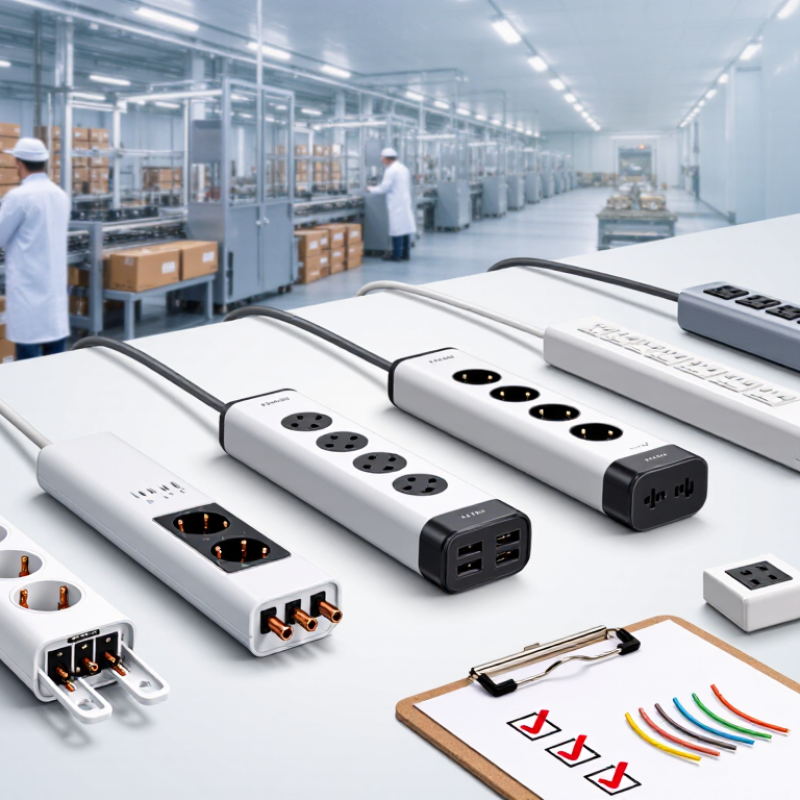
China’s power strips range from basic multi-outlet extensions to models with surge protection or USB charging. They serve desks, kitchens, and workshops, but each design has limits. The International Energy Agency’s Electricity 2024 report says China’s electricity demand grew 6.7% in 2023. That figure covers the whole power system, not power-strip sales; it does underline the value of checking load carefully.
A 10A, 250V rating equals 2,500 volt-amperes; a 16A, 250V rating equals 4,000 volt-amperes. For resistive appliances, these figures roughly match watts, but motor-driven devices may differ. The rating applies to the strip’s combined load, not every socket separately. Follow the product label and applicable GB/T 2099.1 requirements. IEC 60884-1 also sets safety requirements for household plugs and socket-outlets. A higher rating is not a reason to daisy-chain strips. That detail is easy to overlook.
Tips: Add the appliances’ rated currents before plugging them in. Leave room below the strip’s maximum rating, especially for heaters or kettles. If a plug feels hot, stop using the strip and inspect it.
For cord extension sets, safety is more than a neat label. China’s GB/T 2099.7-2015 and IEC 60884-2-7 address this product category, including construction and safety testing. Buyers should review test reports for temperature rise, cord anchorage, and resistance to mechanical stress. Check that the tested model matches the product offered. Similar-looking units may differ inside.
NFPA’s Home Electrical Fires report estimates an annual average of 34,000 U.S. home structure fires involving electrical distribution or lighting equipment during 2015–2019. This broad category is not a power-strip-specific figure. Still, it shows why careful product evaluation matters. Ask suppliers for traceable laboratory reports, clear ratings, and evidence that the exact cord-and-socket configuration was assessed. Paperwork helps, but it is not a substitute for checking the product.
Tips: Inspect the cord entry and socket fit. A clean label alone proves little. If a report’s model number does not match, pause and ask why.
China’s power-strip market includes manufacturers with different strengths: household distribution, computer accessories, electrical equipment, and digital charging products. Buyers should compare those capabilities rather than rely on factory scale alone. A dependable product needs secure sockets, stable contacts, and a housing that resists everyday knocks. Check the rated load and cable details on the product label.
For home use, a clear switch and well-spaced outlets can make a strip easier to use behind a desk or beside a bed. For offices, mounting options and consistent quality across larger orders may matter more. Some suppliers focus on familiar, practical designs. Others invest in USB charging, compact housings, or cable management. Small details matter. A plug that blocks its neighbor is frustrating, even when the specifications look impressive.
Manufacturers should provide clear product documentation and explain how they check finished units. Ask about sample testing, packaging, and traceability before placing a bulk order. Certifications can help, but buyers should verify that documents match the exact model. One awkward truth: a polished catalogue cannot show how a socket feels after repeated use. I would inspect samples and test fit with the plugs people actually use. That extra check takes time, but it can reveal a weak grip or cramped layout early.
| Comparison Dimension | Common Industry Details | What Buyers Should Check |
|---|---|---|
| Product types | Products commonly include basic extension sockets, models with individual switches, surge-protected strips, and USB-equipped versions. | Confirm the intended use, outlet layout, switch configuration, and whether surge protection or USB charging is required. |
| Electrical ratings | Products for mainland China are designed for a 220 V, 50 Hz supply. Socket-outlet products may carry ratings such as 10 A or 16 A, depending on design. | Check the marked voltage and current rating, plug type, and compatibility with the destination market. |
| Applicable standards | Relevant Chinese standards include GB/T 2099.1 for plugs and socket-outlets and GB 1002 for household plugs and socket-outlets. | Verify the applicable standard edition and required approvals for the specific product and sales market. |
| China market certification | Certain electrical products sold in China are subject to China Compulsory Certification (CCC) requirements; applicability depends on product classification. | Confirm whether the exact model is within the CCC catalogue and request valid documentation where required. |
| Safety features | Depending on the model, features may include grounding, child-protection shutters, overload protection, or surge-protection components. | Treat these as model-specific features; check test reports and product markings rather than assuming they are standard. |
| Materials and construction | Enclosures, conductors, contacts, and cable specifications vary by design, rated load, and target-market requirements. | Request material specifications and confirm conductor size, cable type, temperature rating, and enclosure properties for the chosen model. |
| Quality checks | Relevant checks can include visual inspection, electrical continuity, insulation performance, temperature rise, and functional testing. | Ask for the inspection plan, sampling method, and test records for the specific product and production batch. |
| Customization | Depending on the production setup, options may include cable length, housing color, outlet arrangement, packaging, and market-specific plugs. | Confirm tooling needs, minimum order quantities, certification impact, and sample approval before placing a production order. |
Specifications and certification requirements vary by model and destination market; verify them against the product documentation.
When comparing power strip manufacturers in China, look beyond a certificate printed in a catalogue. Ask which product models were tested, which laboratory issued the report, and whether the documents match the units being quoted. Certification requirements vary by destination market, so a useful supplier should explain the relevant standards without treating one mark as universal proof. Request current reports and confirm their scope. Details matter.
Materials affect heat resistance, durability, and everyday safety. Ask for the plastic resin specification and evidence supporting any flame-retardant claims. For conductors, check copper content, wire gauge, and terminal construction rather than relying on phrases such as “heavy duty.” A sample can reveal loose sockets, rough edges, or a flimsy switch. It cannot show long-term performance, though, so sample inspection should sit alongside test records and production checks.
Product range also signals manufacturing capability. A supplier may offer basic indoor strips, models with USB ports, switched outlets, or options with longer cords and different plug formats. Compare these by rated load, outlet spacing, cord length, and available documentation. Not always. A broad catalogue may include products made to different specifications, so confirm the exact configuration and materials for each order. Small omissions in a specification sheet can lead to expensive surprises.
A practical comparison framework for certification, materials, and product range
The chart shows market-level certification status, not manufacturer scores: 2 means required for products within the applicable scope; 1 means voluntary or dependent on customer and local requirements. CCC applies to covered products sold in mainland China, CE marking is required for products covered by relevant EU legislation, and UL or ETL listing is not universally required across the United States. To compare manufacturers, verify certificates and product scope, conductor and plastic specifications, and the range of outlet, switch, and protection options in their product documentation.
When comparing power strip manufacturers in China, start with the rated load, not the outlet count. Add the wattage of devices likely to run at the same time, such as a monitor, printer, and desk lamp. The strip’s rating should comfortably cover that combined load. Check whether the label states voltage, current, and maximum power clearly. Check the label. I would not treat a printed number as proof by itself; ask for product specifications and test documents, then confirm they match the exact model being quoted. A mismatch is easy to miss.
Overload protection deserves the same scrutiny. Ask what protection is built in, how it responds to excess current, and whether replacement or reset instructions are provided. Avoid relying on vague phrases like “heavy duty.” Plug configuration is practical, too: measure bulky adapters, inspect outlet spacing, and confirm cord length and plug type suit the destination market. Fit matters. A dense row of sockets can look efficient, yet block neighboring outlets once real chargers are connected. Request clear photos or a sample when details remain uncertain. Even careful checks cannot predict every use pattern, so leave a sensible margin rather than planning to run the strip at its limit.
Compare product design, documentation, sample checks, and consistency across larger orders. Factory size alone tells little.
Add the wattage of devices used together, such as a monitor, printer, and desk lamp. Leave a sensible margin.
Look for voltage, current, and maximum power. Check the label.
Ask how it works and whether reset or replacement instructions are available. Vague claims are not enough.
Measure bulky adapters and check whether they block nearby sockets. Fit matters.
Request samples, product specifications, test documents, and packaging details. Confirm documents match the exact model.
A sample can reveal cramped spacing or a weak socket grip. Catalog photos miss these details.
Confirm cord length and plug type for the destination market. I would test the actual setup, though that step is easy to skip.
This overview explains how Power Strips made in China serve homes, offices, and workshops, and why choosing the right type matters. It introduces common configurations and the meaning of 10A or 16A current ratings and a 250V voltage rating, while emphasizing that a product’s actual capacity depends on its specifications and intended use. It also outlines the role of safety requirements such as GB/T 2099.7-2015 and IEC 60884-2-7 in guiding design and testing.
Rather than focusing on individual companies, the article compares manufacturers by certification, housing and conductor materials, and the breadth of their product ranges. A practical buyer checklist covers rated load, overload protection, plug and socket configuration, and suitability for the devices being connected. Checking labels, certifications, and operating limits before purchase can help buyers select a reliable power strip and avoid exceeding its rated capacity.